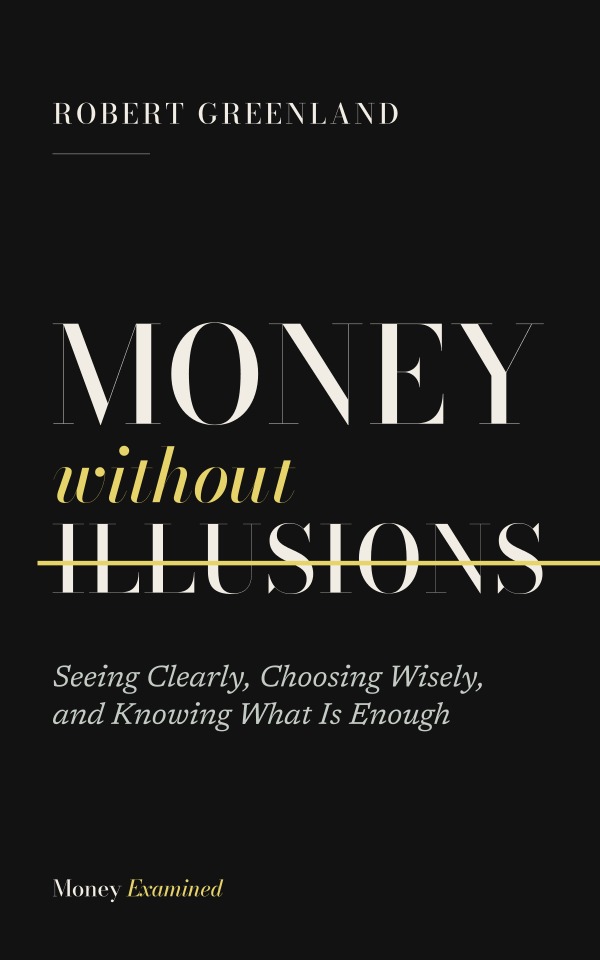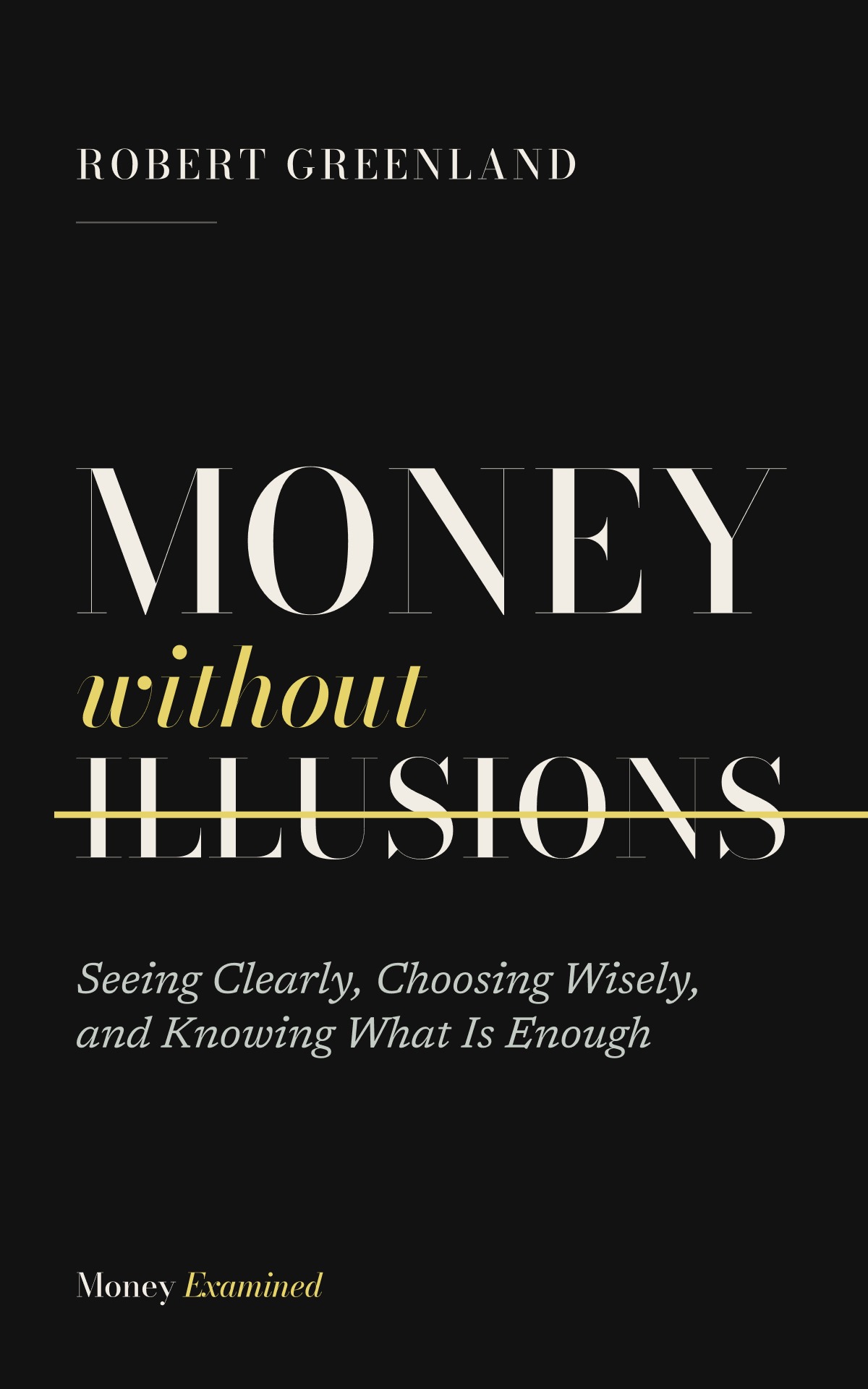
A new book from Money Examined
Money without Illusions
Seeing Clearly, Choosing Wisely, and Knowing What Is Enough
By Robert Greenland
- Complete 179-page edition as a PDF (6 × 9 in)
- Reflowable EPUB for e-readers, tablets and phones
- Both formats in one purchase, one-time payment through Stripe
- Download links on the confirmation page and by email after payment
No court would let a judge decide his own case.
Yet that is how most of us make our largest financial decisions: we gather the evidence, argue both sides, deliver the verdict, and later review it ourselves.
Money Without Illusions argues that the problem is rarely intelligence or character. It is circumstance. Success is real evidence of skill, but it is earned somewhere in particular, and it travels: into larger stakes, different fields, changed markets, and rooms where fewer people are willing to say no.
Across twelve chapters, Robert Greenland follows that pattern through some of the best-documented cases in financial history: John Maynard Keynes nearly ruined in 1920 while being right about Europe, Warren Buffett’s candid accounts of his textile mills and the Dexter Shoe purchase, the neighbors of Dutch and Canadian lottery winners, the cockpit of United Flight 173, the collapse of Barings, and the board of Theranos.
The book then turns to remedies: how to hire a judge for your own decisions, how to decide what is enough, and how Keynes, in his years managing King’s College’s money, made his own judgment correctable.
Every chapter closes with “How sure are we?”, separating documented fact, established research, and the book’s own interpretation; 160 endnotes give the sources. An appendix, “What We No Longer Believe,” corrects popular quotations, statistics, and findings that have not held up. This is not an investment manual. It is a book about the conditions under which good judgment about money survives.
What you’ll take away
Five questions for any significant money decision.
Where did I earn the confidence I am bringing to this decision, and does it apply here? How will I find out if I am wrong, and how soon? Can I afford to be wrong, and for how long? Am I judging this decision, or defending the person who made it? Who can tell me no?
Introduction, “The question at the center of the book”; Conclusion, “Five questions.”
Why success can raise the stakes while scrutiny falls.
The “stake-to-scrutiny gap,” drawn from research on prior gains, overconfident acquirers, and the inquiry into the Royal Bank of Scotland’s purchase of ABN AMRO.
Chapter Five.
How to tell a real check from the appearance of one.
Four tests (standing, independence of interest, independence of view, willingness) and practical ways to build them in with defaults, rules, commitments, and advisers.
Chapters Four and Ten.
Evidence sorted by how far you can rely on it.
Every chapter ends by separating documented fact, established research, and the book’s own interpretation, and an appendix corrects popular myths such as “70 percent of lottery winners go bankrupt.”
Each chapter; Appendix.
A working definition of “enough.”
What recent research says about income and well-being, and why deciding what is enough matters most as a condition of judgment.
Chapter Eleven.
Twelve chapters, three parts.
- Judge in Your Own CauseIntroduction
- How Judgment Is LostPart One
- 1Right Too Early
- 2The Neighbor’s Number
- 3The Self You Cannot Sell
- 4The Quiet Room
- What Success ChangesPart Two
- 5The Larger Stake
- 6Postponed, Not Prevented
- 7The Entrepreneur’s Arithmetic
- 8Borrowed Certainty
- 9When Success Is Skill
- Rebuilding the ConditionsPart Three
- 10Hire a Judge
- 11Enough
- 12The Correctable Mind
- The Conditions, Not the CharacterConclusion
- What We No Longer BelieveAppendix
Every chapter closes with “How sure are we?”, separating documented fact, established research, and the book’s own interpretation. 160 endnotes give the sources.
Read the opening
Introduction: Judge in Your Own Cause
In 1610 the Court of Common Pleas in London decided a lawsuit brought by a physician named Thomas Bonham against the College of Physicians.
Bonham had been educated at Cambridge, took his medical doctorate at Oxford, and practiced in London. The College, which licensed physicians in the city, had refused to admit him in December 1605 and again in April 1606. It fined him and warned him to stop practicing. When he said he would continue, it had him arrested, and on November 7, 1606, he was imprisoned for contempt. His lawyer obtained a writ of habeas corpus, and he was free six days later. Years afterward he sued the College for false imprisonment, and the case came before Sir Edward Coke, Chief Justice of the Common Pleas.
Coke found for Bonham. Much of his reasoning was technical, turning on what the College’s charter and the statutes behind it actually allowed. But the passage that lawyers still quote rested on a different objection. Under its charter the College’s censors summoned the offender, judged him, and took half of the fine. “The censors cannot be judges, ministers, and parties,” Coke wrote: judges to give sentence, ministers to make the summons, “and parties to have the moiety of the forfeiture.” He invoked a maxim that was already ancient, aliquis non debet esse Judex in propria causa, no one ought to be a judge in his own cause, and added a plainer version of his own: “one cannot be judge and attorney for any of the parties.”
Roman law had stated the principle more than twelve centuries earlier, in a decree of the year 376. When James Madison wrote about faction in 1787, in the essay first printed in New York’s Daily Advertiser on November 22 and now known as Federalist No. 10, he gave the reason more bluntly than Coke had. “No man is allowed to be a judge in his own cause,” he wrote, “because his interest would certainly bias his judgment, and, not improbably, corrupt his integrity.”
Notice what the principle does not say. It does not say that judges are stupid or weak. Coke was among the most formidable legal minds England ever produced, and the rule bound him as much as anyone. It makes no claim about the quality of a mind at all. It is a claim about circumstances: that certain arrangements distort judgment whoever is doing the judging, and that the sensible response is not to look for a cleverer judge but to change the arrangement.
Courts have spent centuries acting on that idea. They separate the people who bring cases from the people who decide them. They require judges with an interest to step aside. They give the losing party an appeal to someone else. None of this assumes that judges are fools. All of it assumes that judgment depends on conditions.
Now consider how most of us make our largest financial decisions. When you decide whether to take a job, buy a house, start a business, sell an investment, lend to a relative, or spend a bonus, you are a judge in your own cause. You have the interest. You gather the evidence, frame the question, argue both sides, and deliver the verdict. Later you will decide whether the verdict was sound, and your self-respect may depend on the answer. No court would accept that arrangement. We accept it every day, mostly without noticing that it is an arrangement.
The opening of the Introduction, as it appears in the book (note numbers omitted).

The author
Robert Greenland writes about money, human behavior, and the decisions that shape fortunes.
Money Without Illusions is published by Money Examined. © 2026 Money Examined. First digital edition, 2026.
Explore his books →Questions
What do I receive for $29?
The complete digital edition of Money Without Illusions in two formats, both included in one purchase: a 179-page PDF designed at 6 × 9 inches, and a reflowable EPUB for e-readers, tablets and phones.
Do I have to choose between PDF and EPUB?
No. One purchase includes both files. You receive a separate download link for each.
Is this a one-time payment?
Yes. $29 once, paid securely through Stripe. There is no subscription and nothing renews.
How will I receive my book?
After Stripe confirms your payment you return to a confirmation page with your downloads, and we email you personal download links for the PDF and the EPUB. Stripe sends your payment receipt separately.
Can I read some of it before buying?
Yes. The opening of the Introduction is on this page, with no email required.
Is this financial advice?
No. The book is for educational and informational purposes only. It does not tell anyone what to buy or sell.
What if I change my mind or have a problem with the files?
You can ask for a full refund within 14 days of purchase, for any reason. If a file is faulty or you cannot access it, reply to your purchase confirmation email and we’ll help.